
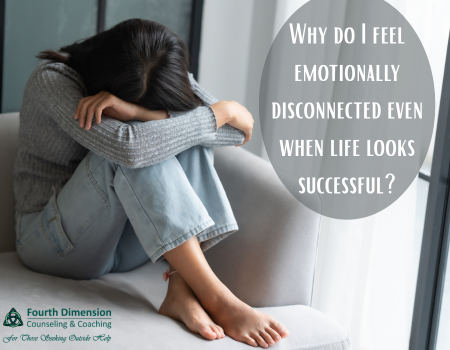
 There’s a specific kind of emptiness or feeling emotionally disconnected that has no good explanation. The job is going well, the relationship is intact, and the life, from any reasonable outside perspective, is working. Yet, something is still absent in a way that’s hard to locate and harder to say out loud because saying it out loud requires admitting that the thing everyone assumed would feel like enough doesn’t quite feel like anything.
Not depression, not grief, and not anything with a shape that makes sense. More like watching your own life from a slight distance and not being able to close the gap regardless of what you do.
The part that makes it harder is the math. People who feel this way are supposed to have reasons, and when the reasons aren’t visible the question turns inward fast. What’s wrong with me? Why can’t I just be grateful? Why does everything feel muted when nothing is actually wrong?
Nothing is wrong; that’s not reassurance, that’s the actual explanation for why this is happening.
Why do I feel emotionally disconnected even when life looks successful?
What the Nervous System Did
This doesn’t arrive randomly. At some point, over enough time, the system that processes emotional experience got overwhelmed and made an adjustment; it created some distance, turning the volume down on feelings because the feelings were too constant, or too much, or too complicated to stay fully open to while also functioning at the level that was required, and emotional detachment happened.
It’s adaptive. It worked, and then it kept working after the original pressure eased, and now it’s just the way things are.
For high-functioning people this process is almost invisible because it happens alongside continued success. The compartmentalizing, the ability to push through, the focus on outcomes rather than experience. These are the same qualities that built everything worth having. They’re also what created the gap. The skill and the cost are the same thing, and that’s the part that’s hard to sit with.
There’s rarely a clear moment when it started. One year things felt real and vivid, and then a few years later they didn’t. Somewhere in between, the shift happened quietly, and nobody noticed, including the person it was happening to.
Burnout Doesn’t End When the Exhaustion Does
The exhaustion piece of burnout gets the most attention because it’s the most visible. Rest enough and it improves. What doesn’t improve on the same schedule is the flatness, the going-through-motions quality, the way things that used to generate genuine feeling stopped doing that somewhere along the way.
People coming out of burnout often describe getting their energy back before getting anything else back. The body recovers, the inside stays somewhere else, and because performance hasn’t dropped and nobody around them knows anything shifted, there’s no external signal that anything needs attention. Which is precisely how this goes unaddressed for years while the person experiencing it quietly wonders if this is just what adult life feels like now.
Sometimes this is depression, and sometimes it sits right next to depression without quite being it. The category matters less than the recognition that it’s real, it has a logic, and it tends not to resolve on its own regardless of how long the waiting goes on.
Why High-Functioning People Wait
The argument against getting support is easy to make from inside this experience. Performance is intact, and nobody else knows anything is different. Other people have visible problems, and this one is hard to explain without sounding like someone complaining about a good life. The feeling will probably pass, is what you tell yourself. It’s been x number of years already, and you keep telling yourself that it will probably pass.
What that argument skips over is the difference between managing a life and actually inhabiting one. Both can look identical from the outside. They don’t feel identical from the inside, and the person living the managed version knows it even when nobody else does.
Waiting for a crisis to make getting support feel justified means waiting for something to get worse. That’s a strategy that delays addressing something that is already mattering and already affecting the actual experience of being alive, just not in ways that show up anywhere visible.
What Therapy Is For Here
Walking into therapy without a specific event that triggered the decision feels uncomfortable for most high-functioning people. There’s no clean answer to what brought you in. The real one, where things look fine and feel hollow and that gap has been present long enough that it deserves more than continued tolerance, is legitimate. It’s also exactly the territory therapy is built to work in.
It’s not to dismantle what’s been built or to relitigate every decision that led here, but to understand what the disconnection developed in response to, what it’s been doing that felt necessary, and whether it still needs to do that or whether something else is possible now.
For people who’ve spent years attending to everything external, turning attention inward is genuinely unfamiliar. That unfamiliarity isn’t a sign that nothing is there. It’s usually a sign of how long it’s been since anyone looked.
Feeling hollow inside a life that looks successful isn’t ingratitude, and it’s not a personality problem. It’s information about something that has been waiting longer than it should have for someone to take it seriously.