 Healing from betrayal or emotional abuse can feel like trying to find your footing after an earthquake. The ground that once felt solid with trust, safety, and love, suddenly feels unstable. Survivors often wrestle with loneliness, self-doubt, and an aching sense that no one could possibly understand what they’ve been through. Yet, one of the most powerful antidotes to that isolation is connection. That’s where group therapy comes in.
In the context of betrayal trauma group therapy, healing happens not in solitude, but in community. The shared experiences of others become mirrors, reminders, and motivators, showing survivors that recovery is possible, and that they are far from alone.
Understanding Betrayal and Emotional Abuse
Betrayal trauma and emotional abuse both target a person’s sense of trust and self-worth. Whether it comes from a partner, parent, friend, or institution, betrayal cuts deeply because it comes from someone you depended on for safety or love. Emotional abuse, on the other hand, slowly erodes confidence and identity through manipulation, gaslighting, and control.
The aftermath often includes symptoms similar to post-traumatic stress: hypervigilance, anxiety, depression, and difficulty trusting others. Survivors may also internalize shame or guilt, believing they should have “seen it coming” or “been stronger.” This internal dialogue creates barriers to healing, barriers that group counseling can gently dismantle through shared empathy and understanding.
The Power of Shared Healing
One of the biggest misconceptions about trauma recovery is that it must be done alone. Many survivors isolate themselves because they fear judgment, or because their abusers convinced them that no one would believe them. Group therapy directly challenges that narrative.
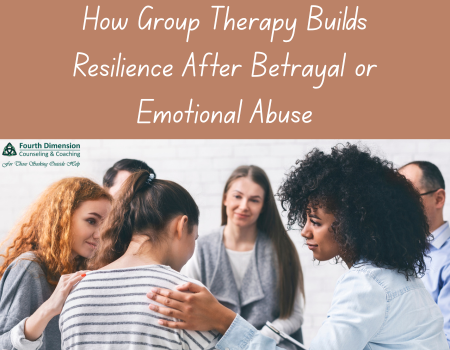
In betrayal trauma group therapy, participants come together in a safe, confidential environment facilitated by a trained therapist. Through guided conversations, they share stories, discuss coping strategies, and learn from one another’s progress.
The simple act of being heard, and hearing others, activates an important part of recovery: social reconnection. Research shows that communal support plays a key role in emotional regulation and resilience building after trauma. When survivors witness others navigating similar struggles, their feelings of shame begin to dissolve. They realize that their reactions are not signs of weakness, but normal responses to deep hurt.
Rebuilding Trust in a Safe Space
After betrayal or emotional abuse, trust feels like a foreign language. Many survivors approach new relationships with fear or suspicion, expecting to be hurt again. Group therapy provides a safe environment to begin relearning trust at a manageable pace.
Every time a participant speaks and is met with empathy rather than judgment, their nervous system receives a subtle message: It’s safe to connect. Over time, these small moments accumulate, rewiring the brain’s association between vulnerability and danger.
This process, known as corrective emotional experience, is one of the most transformative group counseling benefits. It allows survivors to rebuild their capacity for intimacy and openness, without the pressure or risks that personal relationships might carry at the start of recovery.
Learning Through Reflection and Role Modeling
Healing is not linear, and each person in a therapy group is at a different stage. This diversity creates opportunities for growth. Those who are early in their journey gain hope from seeing others who have made progress, while those further along find purpose in encouraging others.
This exchange fosters resilience through modeling and reflection, a concept rooted in social learning theory. Witnessing others reclaim their voice and confidence reinforces the belief that recovery is achievable. The group becomes a living example of healing in motion.
Moreover, hearing different perspectives helps survivors reframe their own stories. A member might say, “I blamed myself too, until I realized manipulation was part of the abuse,” helping another member confront lingering guilt. These realizations are often more impactful coming from peers than from a therapist alone, because they carry the weight of shared experience.
Emotional Regulation and Community Support
Another major benefit of group therapy is the development of emotional regulation skills. Trauma survivors often experience intense emotions like anger, fear, and grief , that feel overwhelming or unpredictable. In a group setting, these emotions can be safely expressed, validated, and understood.
Therapists often guide members through grounding techniques, mindfulness exercises, and communication skills that help them manage emotional responses. With time, participants learn to process their feelings rather than suppress or explode them.
Outside the therapy room, these skills extend into daily life. Many group members report feeling more confident setting boundaries, speaking up for themselves, and maintaining healthier relationships.
From Pain to Purpose
Perhaps the most profound transformation that comes from emotional abuse recovery groups is the shift from victimhood to empowerment. When survivors share their stories and witness others finding strength in theirs, they begin to see their pain differently, not as a mark of brokenness, but as evidence of resilience.
Many participants describe group therapy as the first time they’ve felt truly understood. That sense of belonging rekindles self-compassion, which is often the final step in reclaiming one’s power.
Healing from betrayal or emotional abuse is not a solitary journey, but a shared one. Through betrayal trauma group therapy, survivors discover that connection, not isolation, is the foundation of resilience.
In a world where emotional pain often drives people inward, group counseling offers the opposite: a safe circle where stories are met with empathy, where vulnerability is celebrated, and where healing is collective.
The scars of betrayal and emotional abuse may run deep, but within a supportive group, those scars begin to symbolize survival, as well as the strength to trust, connect, and thrive again.