
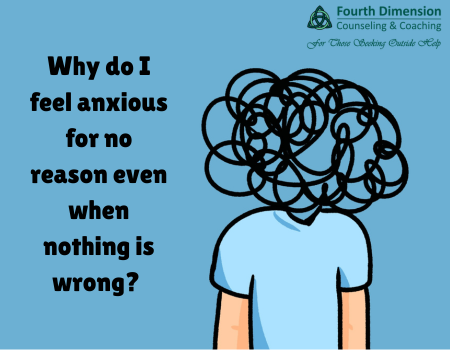
 Anxiety without an obvious reason is disorienting precisely because the mind looks for causes and doesn’t find any that is causing that anxious feeling. Something is wrong. Nothing is wrong. Both feel true simultaneously, and the gap between them is where a lot of people spend significant energy trying to figure out what they’re missing. The search for a reason becomes its own source of anxiety, layered on top of whatever was already there, and the cycle runs without resolution because the cause isn’t where the search is happening.
The absence of an obvious trigger doesn’t mean the anxiety is irrational. It means the cause is somewhere other than the present circumstances.
Feeling Anxious Because The Nervous System Runs on Old Information
The part of the nervous system responsible for anxiety responses was designed for immediate physical threat, and it doesn’t distinguish between a predator and a memory particularly well. Experiences that produced fear or overwhelm at some earlier point get encoded not just as memories but as physical responses—patterns of activation that can be triggered by cues that have nothing obvious to do with the original experience.
This is why anxiety arrives in specific settings, at specific times of day, in response to a smell or a sound, without any apparent logical connection to the feeling. The nervous system recognized something that matched the pattern of an earlier experience and responded before the conscious mind had a chance to evaluate whether the threat was real. By the time the question of why I am anxious gets asked, the response has already been running.
The experience of feeling anxious for no reason is often the experience of a nervous system that learned something specific about safety in an earlier context and is applying that learning to the current one. The current context doesn’t match the original threat. The nervous system doesn’t always know that.
Feeling Anxious Because Anxiety Lives in the Body
Anxiety without an obvious cognitive cause often lives primarily in the body. Tightness in the chest, shallow breathing, low-level physical unease, and restlessness without a specific object. These sensations are the anxiety’s primary expression, and the search for a cognitive reason is the mind’s attempt to explain a physical state rather than a response to an actual identified threat.
The relationship runs in both directions. A physical state that resembles anxiety — elevated heart rate, muscle tension, altered breathing from disrupted sleep or a stressful week — can produce the psychological experience of anxiety without any psychological cause being present. The body is in a state the mind reads as anxious, and the mind starts looking for what’s wrong to explain the feeling rather than recognising that the feeling came from the body’s state.
Caffeine, sleep disruption, blood sugar irregularity, and sustained stress all produce physical states that generate anxiety symptoms regardless of what else is happening. The anxiety feels sourceless because the search for the source is happening at the cognitive level, while the actual cause is physiological.
What’s Running in the Background
Anxiety that feels sourceless is sometimes anxiety with a source that isn’t being attended to. A relationship situation that hasn’t been directly addressed, a professional circumstance that’s been managed around rather than through, a decision deferred rather than made. These generate background activation in the nervous system that doesn’t always surface as a specific worry but contributes to a general unease that feels unconnected to anything specific.
What Therapy Addresses Here
The anxiety that feels sourceless benefits most from a context where the question can be explored rather than managed. The patterns that generate anxiety without obvious cause — nervous system responses to earlier experiences, physical states read as psychological ones, background processing of unattended things — respond to attention in ways they don’t respond to management.
Therapy here isn’t primarily about finding the reason and eliminating it. It’s about developing a different relationship to the anxiety itself. Understanding what the activation is about, rather than just trying to turn it off. Learning what the nervous system is responding to rather than arguing with it for being wrong.
Anxiety that arrives without explanation isn’t random. It has a logic that isn’t always visible from inside the experience. Finding that logic, in a context where there’s enough safety to actually look, is what changes the pattern rather than just quieting it temporarily.
The Anxiety and Depression Association of America’s resources on anxiety cover the range of anxiety experiences, including those without obvious triggers, how anxiety patterns develop, and what evidence-based treatment approaches address them — useful context for anyone trying to understand what they’re experiencing before deciding whether to seek support.