Someone in your family is upset, and you immediately feel the need to fix it. Your partner comes home in a bad mood, and you start wondering what you did wrong. A friend seems disappointed, and you spend the rest of the evening thinking about how to make things better.
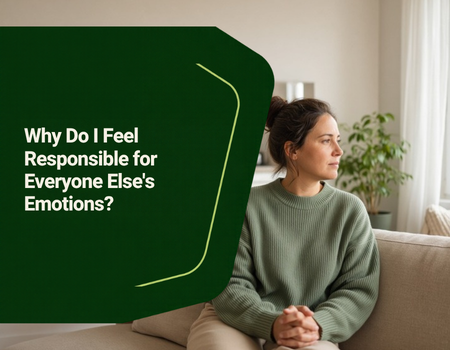
Even when you haven’t caused the problem, you feel responsible for solving it.
Feeling responsible for everyone else’s emotions can develop when you learn to associate other people’s happiness, approval or emotional stability with your own sense of safety. It may be connected to early family experiences, anxiety, conflict avoidance or relationship patterns that developed over many years.
Caring about someone is healthy. Feeling obligated to manage every emotion they experience can become exhausting.
What’s the Difference Between Empathy and Emotional Responsibility?
Empathy means recognizing and caring about another person’s feelings.
Emotional over-responsibility happens when you begin treating those feelings as problems you’re personally required to solve.
For example, you can recognize that your partner is frustrated about work without believing it’s your responsibility to make the frustration disappear.
You can listen to a disappointed friend without automatically changing your plans to prevent them from feeling upset.
The distinction is important because other people are allowed to experience difficult emotions, even when you care deeply about them.
Why Do Some People Develop This Pattern?
There isn’t one explanation that applies to everyone. Several experiences can contribute.
Growing Up Around Unpredictable Emotions
If a parent or caregiver frequently became angry, withdrawn or emotionally unpredictable, you may have learned to monitor their mood closely.
Recognizing early signs of tension might have helped you avoid conflict or prepare for what was coming.
As an adult, that same habit may continue even when you’re no longer in the original environment.
Being Expected to Take Care of Others
Some children take on emotional responsibilities that would ordinarily belong to adults.
They may become the person who comforts a parent, settles family arguments or tries to keep everyone calm.
This is sometimes associated with emotional parentification, although not every child who helps family members experiences an unhealthy role reversal.
The concern arises when a child consistently feels responsible for meeting adult emotional needs at the expense of their own development and well-being.
Fear of Conflict or Rejection
If disagreement has historically led to punishment, withdrawal or rejection, another person’s disappointment may feel threatening.
You may apologize quickly, agree to things you don’t want or avoid expressing your own needs.
The immediate goal is often to restore harmony. Over time, however, the pattern can leave you feeling invisible in your own relationships.
What Are the Signs of Emotional Over-Responsibility?
You might recognize several of these experiences:
- You feel guilty when someone is unhappy, even when you haven’t done anything wrong.
- You monitor people’s tone of voice, facial expressions or text messages for signs of irritation.
- You apologize to end conflict rather than because you believe you’ve caused harm.
- You struggle to say no when someone is disappointed.
- You feel anxious when another person needs space.
- You put your own needs aside to keep relationships stable.
- You become exhausted from trying to anticipate what everyone wants.
These experiences don’t automatically indicate a mental health disorder. They can, however, reveal a relationship pattern worth understanding.
Why Does Someone Else’s Bad Mood Feel Like an Emergency?
For some people, another person’s distress activates a familiar sense of danger.
Your mind may interpret an angry expression or disappointed tone as a signal that something needs immediate attention.
You begin searching for explanations, offering solutions or trying to change the other person’s mood.
This response can occur even when the situation doesn’t require your intervention.
The challenge is learning to distinguish a genuine responsibility from an uncomfortable feeling that you’ve become accustomed to resolving.
How Can This Affect Romantic Relationships?
Emotional over-responsibility can create an unequal relationship dynamic.
One partner becomes the person who constantly monitors, reassures and adjusts. The other partner may become accustomed to having their emotions managed.
Eventually, resentment can develop.
You may feel that you’re doing all the emotional work while struggling to explain why the relationship feels so tiring.
Healthy relationships involve mutual care, but they also require each person to take appropriate responsibility for their own emotional responses and behavior.
Couples counseling and relationship therapy can help partners examine these patterns and develop healthier communication.
Can You Care About Someone Without Fixing Their Feelings?
Yes. In fact, allowing someone to experience their own emotions can be an important part of a healthy relationship.
Consider the difference between these responses:
Taking responsibility: “You’re upset. I need to figure out how to make you happy again.”
Offering support: “I can see you’re having a difficult day. Would you like to talk about it?”
The second response offers connection without assuming control.
You can listen, show compassion and offer appropriate help while recognizing that another person’s emotional experience ultimately belongs to them.
How Do You Begin Changing the Pattern?
1. Notice When You Automatically Take Responsibility
Before trying to solve another person’s problem, ask yourself whether they requested help or whether you’re responding to your own discomfort.
2. Separate Feelings From Behavior
Someone may feel disappointed by a reasonable decision you’ve made.
Their disappointment doesn’t necessarily mean your decision was wrong.
3. Practice Allowing Discomfort
You don’t have to immediately repair every awkward conversation or disagreement.
Allowing ordinary relationship discomfort to exist can help reduce the urge to manage everyone else’s reactions.
4. Identify Your Own Needs
If you’re accustomed to focusing on everyone else, answering a simple question such as “What do I want?” may take practice.
Start with everyday decisions and work toward expressing more important preferences.
5. Consider the Role of Earlier Experiences
Understanding where a pattern developed can help you recognize why it feels so automatic today.
Fourth Dimension Counseling & Coaching provides counseling for childhood trauma, family-of-origin concerns, relationship difficulties and emotional abuse recovery.
When Does This Become an Unhealthy Relationship Pattern?
The issue becomes more concerning when managing another person’s emotions consistently comes at the expense of your own safety, independence or well-being.
For example, you may stop seeing friends because your partner becomes upset, avoid expressing opinions to prevent arguments or feel responsible for another person’s threatening behavior.
These situations deserve careful attention.
Boundaries alone may not resolve a relationship involving intimidation, coercion or abuse. Individual support and safety planning may be more appropriate than couples counseling when abuse is present.
How Can Counseling Help?
Counseling can provide a structured place to examine the beliefs and experiences underlying emotional over-responsibility.
Depending on your circumstances, therapy may focus on recognizing automatic responses, understanding family-of-origin patterns, practicing boundaries and developing greater tolerance for ordinary interpersonal discomfort.
The goal isn’t to stop caring about others.
It’s to develop relationships where compassion doesn’t require sacrificing your own emotional needs.
Fourth Dimension Counseling & Coaching offers individual counseling and therapy for relationship concerns, anxiety, childhood trauma and emotional difficulties, along with couples counseling when appropriate.
Frequently Asked Questions
Why do I feel guilty when someone else is upset?
You may have learned to associate another person’s distress with personal responsibility, conflict or rejection. Guilt doesn’t necessarily mean you’ve done something wrong.
Is feeling responsible for everyone’s emotions a trauma response?
It can be associated with difficult childhood experiences or trauma, but it can also develop through learned relationship habits, anxiety or other influences. The pattern alone doesn’t establish a trauma diagnosis.
Is this the same as people-pleasing?
They often overlap. People-pleasing involves prioritizing others’ approval or comfort, while emotional over-responsibility specifically involves feeling obligated to manage how other people feel.
Can I set boundaries without hurting someone’s feelings?
Not always. Reasonable boundaries can still disappoint people. The goal is to communicate respectfully, not to guarantee that nobody experiences discomfort.
Can therapy help me stop taking responsibility for everyone?
Therapy can help you understand the pattern, recognize emotional triggers and practice healthier boundaries and relationship skills.
You Can Care Without Carrying Everything
Being compassionate doesn’t require becoming responsible for everyone else’s happiness.
You can support people you love, acknowledge their emotions and maintain meaningful relationships without constantly managing their reactions.
Fourth Dimension Counseling & Coaching provides individual and relationship counseling through its Washington-based practice, with secure online therapy available in multiple states where its clinicians are licensed.
To discuss emotional boundaries, relationship patterns or family-of-origin concerns, contact Fourth Dimension Counseling & Coaching or call 425-652-1690.