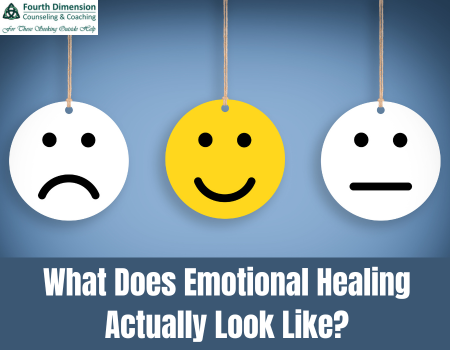
People come into therapy expecting to feel better, and that’s a reasonable expectation. It’s also the expectation that makes the first several weeks confusing, because the early stages of real emotional healing often feel worse, not better, and nobody warned them that was coming.
This isn’t the therapy failing; it’s usually the first sign it’s working.
Understanding How Emotional Healing Works
 What Actually Happens Early On
Most people arrive in therapy having spent years managing difficult issues through strategies that mostly work, staying busy, keeping certain things at a distance, and not looking too closely at specific things. The strategies are functional, and they do their job. It’s important to note that therapy starts examining them rather than using them, and when that happens, what they were containing becomes more present rather than less.
The person who arrives feeling numb and starts feeling grief a few weeks in hasn’t gotten worse. The numbness was doing something, while the grief is what was underneath it, and that’s not a setback; rather, that’s contact with the actual material.
Progress at this stage doesn’t look like feeling better. It looks like noticing things, a pattern recognized while it’s running rather than only after it has done some damage, and an emotional state identified in the moment rather than only through its aftermath. These shifts are small enough that most people do not register them as significant, but they are. They are evidence of something changing at the level where change actually needs to happen, which is not the same as feeling more comfortable.
The Part Nobody Talks About
Sometimes, real progress in emotional healing gets interrupted; there’s a stretch where things feel genuinely different that gets followed by a week where everything feels stuck or worse. A session that produces something real gets followed by several sessions that feel like going in circles, and most people interpret this as losing ground.
However, they haven’t lost ground. The difficult stretch following a period of progress isn’t the progress being undone; it’s the process going deeper, meeting the next layer, or responding to something in the person’s life that’s activating the same material being worked on in sessions. The person who felt meaningfully different for two months and then had a hard few weeks isn’t back where they started. They’re working at a depth they weren’t working at two months ago.
That distinction is almost impossible to feel on a hard day, but it becomes clear much later, when the person looks back and realizes how far they’ve actually come from where they were a year ago.
The most honest indicator of progress during this phase isn’t how the good days feel; it’s how long the hard ones last. A difficult period that used to stretch for three weeks now moves through in ten days. An activation that used to produce days of shutdown now produces an afternoon of difficulty and then passes. Recovery time shortening is real, but it just doesn’t feel like an achievement when it’s happening.
Why Progress Is Easy to Miss
Healing tends to show up as the absence of something rather than the arrival of something new. There’s rarely a clear moment where a person can point and say that’s when it changed.
What shows up instead is quieter than that: a relationship that doesn’t follow the old pattern, a boundary that got set without the guilt that followed every previous attempt, a hard conversation that happened without the flooding or shutdown that hard conversations used to produce, and a trigger that landed as something recognizable and manageable instead of something overwhelming. None of these feels like victories; they are just ordinary moments where the old way didn’t happen.
Therapists often see these before clients do. The session where someone describes a situation that would previously have sent them into a tailspin, and they describe it plainly, without drama, is frequently the session where the therapist recognizes something significant that the client hasn’t thought to name as progress. Apparently, the client has moved through something that would have stopped them before, but they just didn’t notice because nothing dramatic happened, and nothing dramatic happening was the point.
On the Timeline
Emotional healing doesn’t move on a fixed schedule. The timelines that get attached to therapy- six weeks, twelve sessions, and a structured program, usually reflect what insurance billing or service models require, not what the process actually takes for the people doing real work on real material.
For people whose pain has roots in early experiences, in patterns that formed before they had language for what was happening, or in experiences that taught the nervous system to organize itself around protection, the work takes longer than most people initially expect. That’s not inefficiency, that’s the nature of material that developed over years and revises on a timeline that reflects its actual depth.
The changes that hold are the ones that happened at the level where the pain was actually located, and not at the surface, where it was most visible.
What Emotional Healing Actually Looks Like in the End
Therapy for trauma and emotional pain in Seattle and Bellevue looks like consistent work with someone who understands what’s being worked through. It looks like periods of difficulty that belong to the process rather than signaling that the process is broken, gradual shifts that accumulate over months, and eventually, a different relationship with the original pain.
The pain that was quietly happening in the background becomes something the person knows about, rather than something running their life without their awareness. They know it’s there, but it just doesn’t run everything anymore.
The National Institute of Mental Health’s trauma recovery resources cover what the research shows about the therapeutic process for trauma and emotional pain, what realistic timelines look like for different presentations, and what evidence-based approaches produce durable outcomes rather than temporary symptom reduction — authoritative federal research context that supports the article’s core argument about why emotional healing takes the time it takes and why the non-linear nature of the process is a feature rather than a flaw.